|
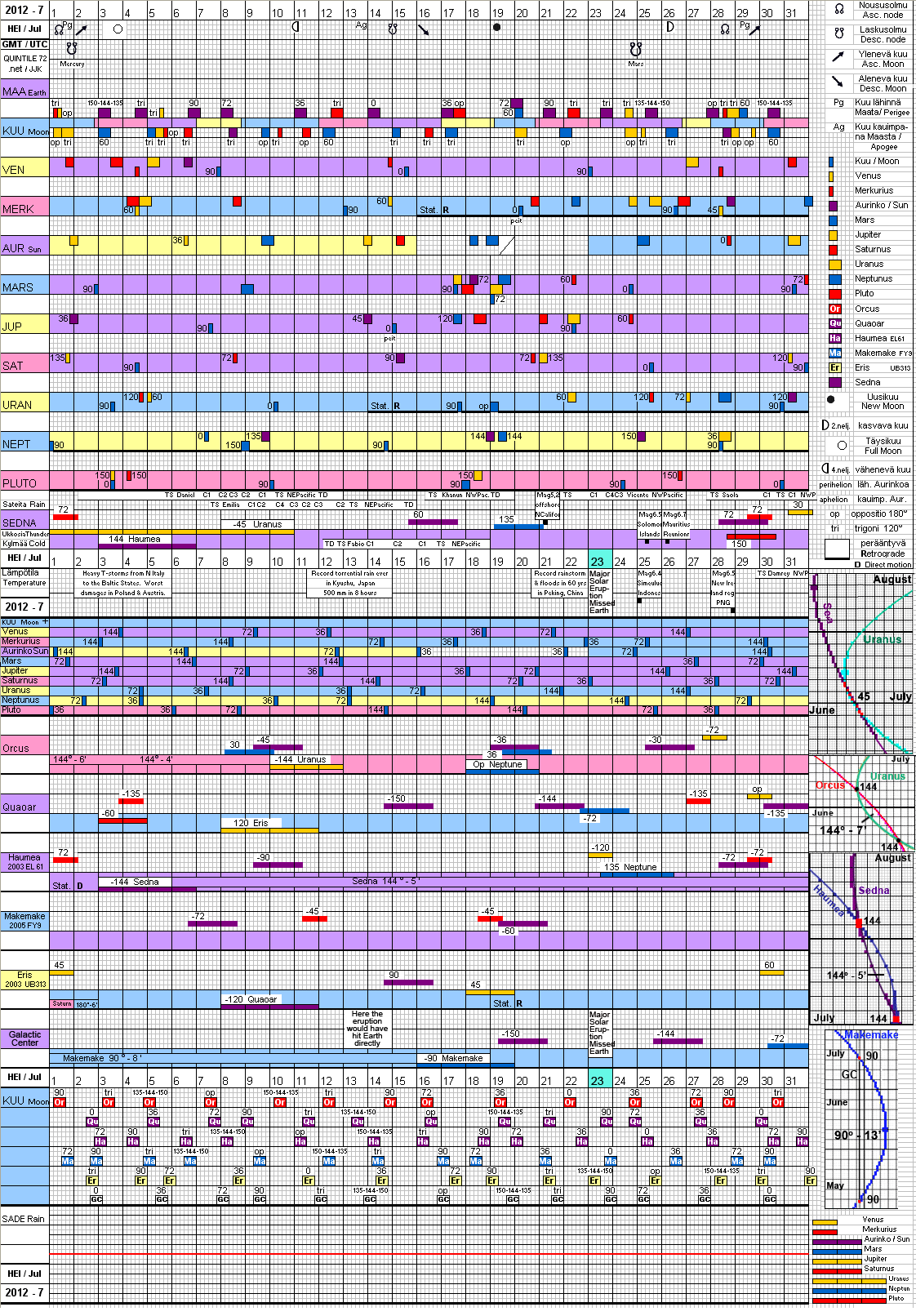
SOLAR ERUPTION 23 July 2012
On 23 July 2012 the Sun produced one of the most powerful solar eruptions of the modern era.
It originated in the active region AR1520, when two consecutive CMEs merged into a super-eruption — an exceptionally strong combined outburst.
NASA's STEREO–A spacecraft was hit directly, but Earth escaped — by only about one week of timing.
STRENGTH OF THE ERUPTION
The eruption was exceptionally powerful, with the following key parameters:
– speed up to 2000–3000 km/s
– estimated travel time to Earth only 14–18 hours
– magnetic field Bz down to -52 nT — a value capable of producing a G5–class geomagnetic storm.
NASA compared the event directly to the 1859 Carrington eruption.
Had this one been Earth–directed, power grids and satellites would have experienced severe, global-scale disruptions.
SYNCHRONY OF THE ANGLES
The eruption occurred exactly on the day when Makemake formed a 90° angle to the Galactic Center.
This angle is associated with the water element, magnetic fields, and sudden releases of accumulated energy.
Its influence did not operate on a single day only, but for several weeks before and after the exact point.
The Sun's magnetic field was already unstable, and the tension that had built up by late July discharged abruptly.
This Makemake–GC angle had been identified early on as a "potential eruption window".
This foresight is described on the page Summer 2012, where the angle was analyzed prior to the event.
MARS AT THE NODE — 24 July 2012
On the following day Mars passed through the nodal point (the intersection with the ecliptic), strengthening the reactivity of the water element and magnetic phenomena.
The particle streams from the solar eruption were at their strongest precisely at that time.
SUMMARY
The July 2012 event forms a clear sequence:
– Makemake 90° GC — magnetic tension
– 23 July 2012 CME — release of the eruption
– Mars at the node on 24 July — amplification of the after-resonance.
This is one of the clearest examples of how slow cosmic angles and solar cycles resonate with one another.
Earth avoided a direct impact by only a few days.
More information about the Sun's functioning and the perspective of extended natural science can be found in the book
NÄE KAUEMMAS SÄÄHÄN (2022).
|